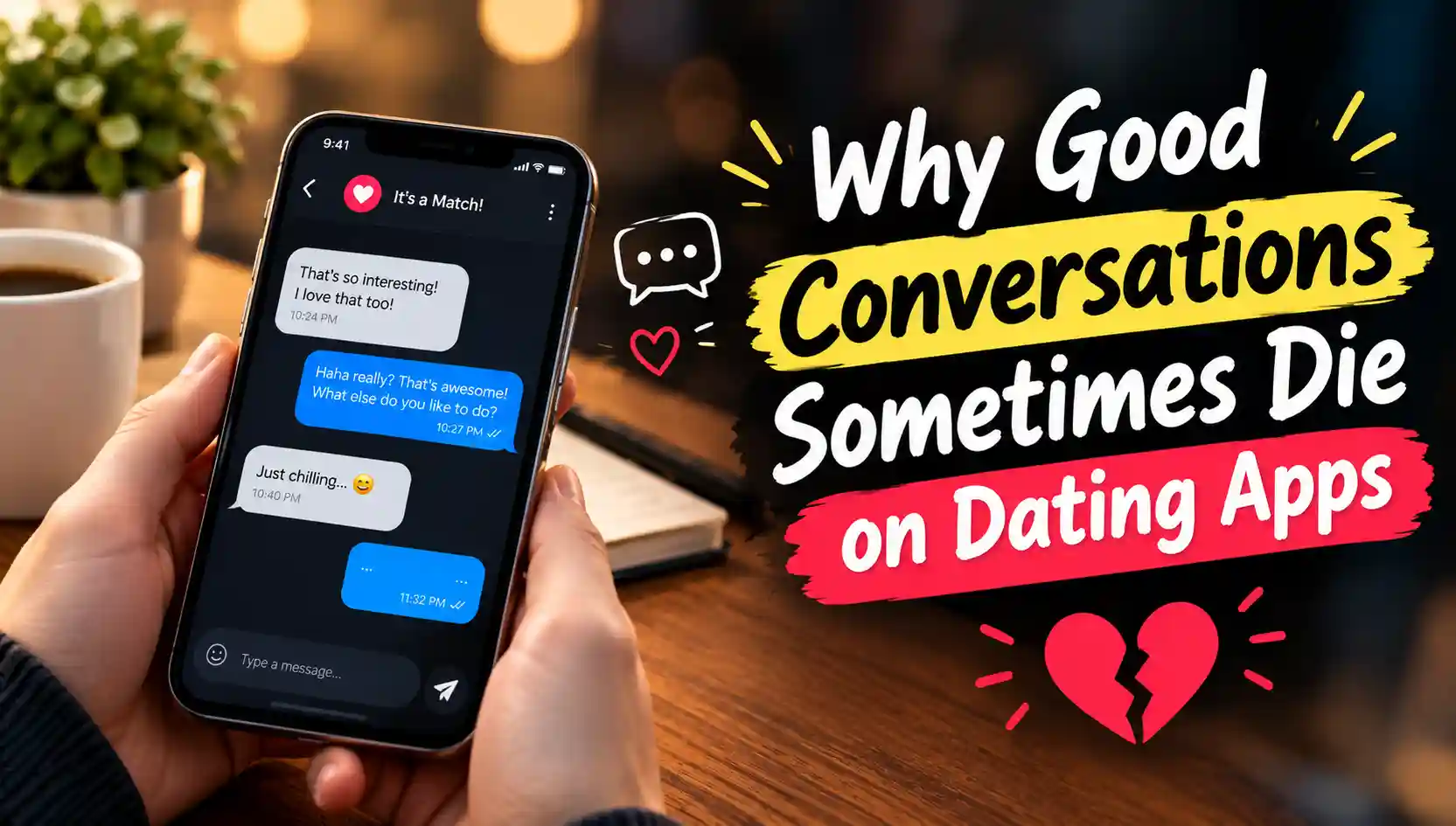
You match with someone on a dating app. The conversation starts surprisingly well. There is no awkward small talk, both of you are replying quickly, and within a few messages, you are actually laughing at each other’s jokes.
Then something changes.
Replies become shorter. The gaps between messages get longer. One day, you send a message and receive nothing.
You start wondering what happened.
Did you say something wrong? Did they lose interest? Were they talking to someone else? Or was the conversation never as good as you thought?
The frustrating truth is that a good conversation on a dating app can die for many reasons, and not all of them have anything to do with you.
1. A Good Conversation Doesn’t Always Mean Romantic Interest
One of the biggest mistakes people make on dating apps is assuming that a fun conversation automatically means the other person is interested in taking things further.
It doesn’t.
Someone can genuinely enjoy talking to you without feeling romantic chemistry. They may like your humor, find your stories interesting, or simply enjoy having someone to talk to.
Dating apps make this especially confusing because a match creates the expectation that both people are interested in each other.
But matching is only the beginning.
Real attraction usually requires more than good conversation. There needs to be some combination of curiosity, chemistry, compatibility and timing.
That’s why a conversation can feel great while still going nowhere.
2. The Conversation Becomes an Interview
Another common reason conversations die is that they start feeling like job interviews.
You ask:
“Where are you from?”
“What do you do?”
“What are your hobbies?”
“What do you do on weekends?”
The other person answers, and then you ask another question.
Technically, the conversation is continuing. Emotionally, it isn’t.
Good conversations usually aren’t just a series of questions and answers. They involve reactions, opinions, humor, stories and unexpected turns.
Instead of asking only, “What do you do for fun?”, you could share something about yourself first:
“I’ve recently realized that my idea of a perfect weekend is basically good food and absolutely no plans.”
That gives the other person something to react to rather than forcing them to provide another interview-style answer.
3. One Person Is Carrying the Conversation
Sometimes the conversation doesn’t die suddenly. One person simply gets tired of keeping it alive.
You send the first message.
You ask the next question.
You introduce a new topic.
You respond thoughtfully.
Then you notice that the other person rarely starts anything themselves.
This is important.
A conversation needs some level of reciprocity. If one person is constantly providing the energy, eventually it becomes exhausting.
You shouldn’t have to perform a one-person comedy show just to keep a dating-app chat alive.
If someone repeatedly gives short answers without showing curiosity about you, the problem may not be that you haven’t found the “perfect message.” They may simply not be sufficiently interested.
4. The Conversation Becomes Too Serious Too Quickly
There is nothing wrong with meaningful conversations. In fact, they can be much more interesting than endless small talk.
The problem is timing.
If you’ve exchanged only a handful of messages and suddenly start discussing marriage, past relationships, emotional wounds, financial expectations and your entire five-year life plan, the other person may feel overwhelmed.
Dating is partly about discovering someone gradually.
You don’t need to reveal everything immediately.
A little mystery isn’t a bad thing. It gives both people reasons to continue talking.
5. You’re Talking Too Much About Yourself
This one is easy to miss.
Someone asks you a question, and you give a detailed answer. Then you tell another story. Then another.
The conversation may feel interesting to you because you’re sharing things you’re passionate about.
But the other person may eventually feel like an audience rather than a participant.
A good conversation has balance.
Share something about yourself, but leave room for the other person to contribute. If they mention that they recently traveled somewhere, don’t immediately turn the topic into your own travel history.
Ask what they liked about the place. Ask what surprised them. Tell them about a similar experience you’ve had.
That’s how a conversation becomes collaborative instead of one-sided.
6. The Messages Become Predictable
“Good morning.”
“How was your day?”
“What are you doing?”
“Had dinner?”
“Good night.”
These messages aren’t necessarily bad. But if that’s all the conversation contains, it can become repetitive very quickly.
Dating-app conversations need something to create momentum.
It could be a funny observation, an unusual question, a playful disagreement or a story from your day.
For example:
“What’s a completely unnecessary thing you would still spend money on?”
is usually more interesting than:
“What are your hobbies?”
The goal isn’t to constantly entertain someone. It’s simply to give the conversation somewhere to go.
7. People Get Busy
This is probably the most boring explanation—and sometimes the correct one.
People have jobs, classes, family responsibilities, friends, travel, stress and entire lives outside the dating app.
A delayed response doesn’t automatically mean rejection.
One slow reply means almost nothing.
A consistent pattern of disappearing, returning with minimal effort, and never moving the conversation forward means considerably more.
The mistake is trying to interpret every individual message.
Look at the pattern instead.
8. Too Many Matches Can Reduce Attention
Dating apps can create an unusual problem: having too many conversations at once.
Someone might match with several people during the same week. Even if they are genuinely interested in you, their attention is divided.
Your conversation may not have become worse. It may simply have been pushed down the list.
This is one reason dating apps can feel different from meeting someone in real life.
In person, you generally have one interaction happening at a time. On an app, you’re competing with notifications, other conversations and the person’s offline life.
That’s not necessarily personal.
9. The Conversation Never Moves Forward
Sometimes a conversation dies because it stays in the same place for too long.
You chat for days.
You joke.
You exchange stories.
But neither person suggests doing anything outside the app.
Eventually, the conversation starts feeling like an endless messaging friendship.
If there is genuine mutual interest, eventually someone usually has to create a next step.
It doesn’t need to be dramatic.
A simple:
“We’ve been talking about coffee for three days. We should probably test whether we’re equally opinionated about it in real life.”
can be enough.
The important thing is that the conversation develops rather than endlessly repeating itself.
10. The Chemistry Simply Isn’t There
This is the hardest possibility to accept.
Sometimes you can do everything “right” and the conversation still fades.
There may be no obvious mistake.
No offensive message.
No awkward question.
No major disagreement.
Just a lack of chemistry.
Chemistry is difficult to manufacture through texting. Two people can have similar interests, attractive profiles and perfectly reasonable conversations and still not feel that particular connection.
That’s normal.
Dating isn’t an exam where following the correct rules guarantees a successful outcome.
11. People Sometimes Change Their Minds
Someone can be interested on Monday and less interested on Friday.
That doesn’t necessarily mean they were pretending before.
Feelings can change. Circumstances can change. Someone can realize that they’re not ready to date. They can reconnect with an ex. They can meet someone else. They can simply decide that the connection isn’t what they expected.
You can’t control another person’s level of interest.
What you can control is how you respond.
Repeatedly sending messages because you’re trying to force the old energy back usually doesn’t help.
12. You’re Trying Too Hard to Keep It Alive
Ironically, the harder you try to prevent a conversation from dying, the more unnatural it can become.
When people sense that a conversation is slowing down, they sometimes start sending more messages, asking increasingly random questions or desperately searching for another topic.
That can create pressure.
Instead, pay attention to reciprocity.
If the other person is interested, you shouldn’t have to manufacture every interaction.
Give the conversation room to breathe.
Sometimes the best move is simply to stop chasing and see whether the other person comes back.
What Should You Do When a Good Conversation Starts Dying?
First, don’t panic.
Don’t immediately assume you’ve done something wrong.
Look at the overall pattern.
Are they still asking questions?
Do they initiate conversations?
Are their replies thoughtful?
Do they remember things you’ve told them?
Do they seem interested in meeting?
Or are you doing almost all of the work?
If the conversation has only slowed temporarily, give the person some space.
If you genuinely want to restart it, send one natural message connected to something you’ve previously discussed. Don’t send five follow-ups trying to get a response.
And if the effort remains completely one-sided, accept the information you’re being given.
You don’t need to convince someone to be interested in you.
The Bigger Lesson
A dating-app conversation dying doesn’t always mean you failed.
Sometimes the conversation dies because of poor communication. Sometimes it’s bad timing. Sometimes the interaction becomes repetitive. Sometimes one person loses interest. And sometimes two people simply don’t have enough chemistry to keep things going.
The useful skill isn’t learning how to keep every conversation alive.
It’s learning how to recognize which conversations are actually worth continuing.
Healthy dating isn’t about chasing every match until they respond. It’s about finding someone who contributes to the interaction as naturally as you do.
When the interest is mutual, conversation usually doesn’t feel like a responsibility.
It feels like something both people want to continue.